


Brain research shows that early reading requires development of neural pathways linking speech to new learning about print. Memorizing the visual appearance of words does not require the same participation of speech. More efficient brain pathways develop as children master PA, phonics, the alphabet code, and word knowledge in order to encode and decode meaningful text . . . When these neural maps are created and repeated, familiar words are no longer decoded intentionally, but are recognized automatically.
Neuropsychologist Jeannine Herron, Reading Rockets
Using Principles to Inform Practice
I was in my second year of a job share at the first-grade level, having spent eight years teaching high school English, when I stumbled upon Why Our Children Can’t Read and What We Can Do About It: A Scientific Revolution in Reading (1997) by cognitive psychologist Diane McGuinness.
Children are wired for sound, but print is an optional accessory that must be painstakingly bolted on . . . We need to understand how the contraption called writing works, how the mind of the child works, how to get the two to mesh . . . All the familiar [reading] techniques were devised before we had a scientific understanding of reading, and they are based on theories we know are wrong.
Steven Pinker, Foreword, Why Our Children Can’t Read and What We Can Do About It
Because my preservice program prepared me to be a high school English teacher—not an elementary school reading teacher—I had no idea how the contraption called writing works and what those beginning reading techniques based on theories we know are wrong were until I read the book. I was simply relieved to find that everything McGuinness wrote about Linguistic Phonics (LP) made sense as I embarked upon working as an elementary school reading specialist, and student success has meant I’ve never needed to look back on the methods she promoted. In particular, she states unequivocally:
From research in the classroom and the clinic, we have discovered that when the sequence of reading and spelling instruction is compatible with the logic of the alphabet code and with the child’s linguistic and logical development, learning to read and spell proceeds rapidly and smoothly for all children and is equally effective for poor readers of all ages.

In this piece, I discuss the importance of understanding basic reading principles, creating a sound structure in the classroom based on these principles, and developing simplified routines to teach these principles. I have recently found these principles, structures, and routines emphasized in the new paper, “Re-examining Foundational Literacy Instruction in the United States: A Case for Linguistic Phonics”1 by Jennifer Newman and Svetlana Cvetkovic. They state:
Linguistic Phonics offers a coherent instructional paradigm that makes the connections between speech, print, and meaning explicit from the start. By aligning instruction with how children process spoken language and how the writing system maps onto it, LP integrates essential elements of literacy into a practical, unified framework . . . This paper presents LP as a promising model for recalibrating foundational skills instruction by aligning instruction with how children become literate—building on shared goals while addressing often-overlooked aspects of reading development.
This comprehensive paper from two LP practitioners offers a roadmap leading us away from phonics-filled lessons that are too complicated and cumbersome—and time-consuming—toward a brain-friendly approach to reading. The path forward is clearly laid out with enough evidence to suggest the likelihood that a shift to Linguistic Phonics won’t let us down. Even if LP were only equally as effective as other phonics approaches, its efficiency alone would be enough to recommend it.

Timothy Shanahan states:
These teaching methods [beginning reading instruction with what the brain has been primed for] encourage much spelling and writing activity – actions that require students to think about what letters represent the language sounds and word pronunciations, rather than solely focusing on sounding out written words.
From Acquisition to Adaptation
Newman and Cvetkovic emphasize the importance of six characteristics of LP, which I will explain with examples from my own lessons.
The Spoken Word: There are far fewer sounds than there are spelling patterns, so beginning with speech and attaching print to it simplifies instruction. We can ask our students both What do you hear? and What do you say? when they are segmenting a word. From Jeannine Herron on SPELL-Talk: As children segment a dictated word and learn to place letters in the correct sequence to spell a word (NAP or PAN), it is the recognized actions of their own mouths that guide their decisions about letter placement.
A Reversible Code: Because the code is reversible, after we begin with speech, we are quick to represent that speech with print so that encoding (writing) sounds is immediately followed by decoding (reading) the print. In fact, this encoding process where students say the phoneme as they write the grapheme actually promotes reading development by applying phonemic awareness skills as the words are segmented and represented in print. We have learned from the research by Ouellette and Sénéchal that giving emergent readers plenty of opportunities to write is important in order to strengthen phonemic awareness skills.
Routines: In the book Brain Words: How the Science of Reading Informs Teaching, (2019) Richard Gentry and Gene Ouellette recommend the routine: hear it, say it, write it, read it, use it. In the article, Newman and Cvetkovic emphasize say-spell-write. In both cases, the important point is that students are combining letters, sounds, and meaning—phonology, orthography, and semantics—to promote orthographic mapping, which is necessary for automatic word recognition (see What Was She Thinking: Linnea Ehri Explains Orthographic Mapping).
Set for Variability: During my training in the LP program Phono-Graphix, I was taught to prompt a student to correct a mispronounced word by saying, Try a different sound. It was many years later that I became familiar with the term set for variability, also known as flexible pronunciations. Needless to say, this technique is invaluable when reading a writing system that can have multiple pronunciations for a single spelling pattern.
Multisyllabic Instruction: An emphasis on multisyllabic instruction during beginning reading can seem counterintuitive and counterproductive, but when we realize that a multisyllabic word like fantastic can be broken down into three CVC parts: fan tas tic, we can understand its value. By applying the encoding routines taught, one of my kindergartners was able to write mac don l in a story about having lunch at McDonald’s after a visit to the zoo. This same student wanted to write about a new toy and asked me, What does /oy/ look like, indicating that he understood that letters are pictures of sounds. So I showed him on his white board even though we hadn’t covered the ‘oi’ and ‘oy’ spelling patterns. My student carries his speech with him wherever he goes and uses it for both reading and writing.
Quick Feedback: Error correction is multifaceted, but suffice it to say that when I am dictating words and sentences to my K-1 students, and they hold up their white boards when finished, I am able to quickly correct errors and then write the corrected version on the board, while also taking time to analyze the errors if this analysis is helpful. Making mistakes is inevitable, but I don’t want students to practice their mistakes. The revised truism isn’t that practice makes perfect; it’s practice makes permanent. However, it’s also important to note that although we emphasize correctness, we don’t allow our teaching to be crippled by lack of mastery, as the authors explain here:
Because many Structured Literacy approaches prioritize accurate recall of individual components before introducing new material, the IDA notes that mastering the English code may take several years of systematic, explicit instruction, especially for students with dyslexia (IDA, 2020). While this level of precision supports accuracy, it can also slow momentum and delay students’ access to purposeful reading. Linguistic Phonics takes a different view: Mastery is not an endpoint, but a process that unfolds through use. Students apply knowledge through immersive reading and writing tasks that enhance engagement, deepen understanding, and draw their attention to orthographic patterns. By engaging in meaningful reading and writing, students begin to rely less on external guidance and more on internalized knowledge, eventually reaching a point where learning accelerates independently, much like achieving escape velocity (Seidenberg, 2024).
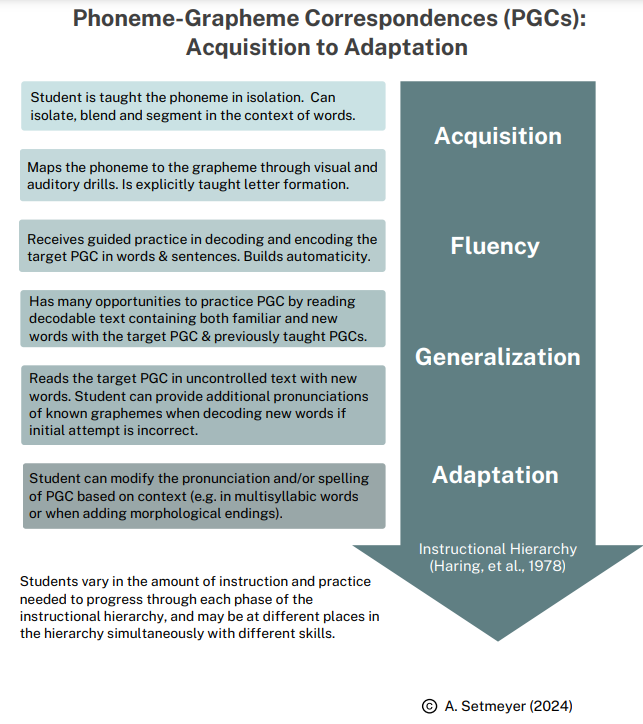
Note in this infographic depicting the instructional hierarchy, Andrea Setmeyer (The Reading League) positions the reading of uncontrolled text following the many opportunities to practice phoneme-grapheme connections in decodable text. Newman and Cvetkovic make a point of emphasizing that the transition between texts tends to happen sooner in LP approaches. They explain:
A related factor is how texts are used. In some classrooms, decodable books may become the main teaching tool rather than a scaffold to reinforce sound-symbol links . . . Overreliance on controlled texts or picture cues may limit acquisition of these skills. Duke and Mesmer (2018) contend that phonics disconnected from real reading can hinder transfer. LP addresses this by moving into authentic texts once core skills are established, blending explicit teaching with meaningful use. As Castles et al. (2018) explain, once students grasp basic correspondences, wide reading drives further code learning and builds deeper code knowledge, not the reverse.
This is an important point since we want students to apply their skills to meaningful reading and writing, which promotes other literacy components like vocabulary and knowledge acquisition.
The Possibilities of the P.O.S.S.U.M.

I have discussed Maryanne Wolf’s emphasis on the importance of multicomponent instruction, which is a feature of Linguistic Phonics. Newman and Cvetkovic emphasize the integration of literacy components because it allows the application of skills taught within a wide variety of contexts. The P.O.S.S.U.M. acronym Wolf introduces represents:
P. Phonology, Phoneme Awareness, Prosody, Pragmatics
O. Orthographic Patterns
S. Semantics
S. Syntax
U. Understanding the alphabetic principle and meanings within text
M. Morphology
These elements are also reflected in the LP Prototype that Diane McGuinness presents in Early Reading Instruction: What Science Really Tells Us about How to Teach Reading (2004). I’ve listed her prototype below and have added in parentheses researchers who have promoted the practices she recommends.
Note in the first bullet point that what Diane McGuinness is referring to as sight words are high-frequency words that are memorized as a whole—not words that become recognized by sight after they have been orthographically mapped by connecting phonology, orthography, and semantics (sounds, spellings, and meaning)—which include all words, not just those that are high-frequency. And in the second bullet point, clarification is also needed. It is important to separate teaching the sounds of letters as part of reading instruction and teaching the names of letters for use as labels. (Bolded words were originally italicized in the book.)
No sight words (except high-frequency words with rare spellings). (Linnea Ehri)
No letter names. (Stanislas Dehaene)
Sound-to-print orientation. Phonemes, not letters, are the basis for the code. (Richard Gentry and Gene Ouellette)
Teach phonemes only and no other sound units. (Susan Brady)
Begin with an artificial transparent alphabet or basic code: a one-to-one correspondence between 40 phonemes and their most common spelling. (David Share)
Teach children to identify and sequence sounds in real words by segmenting and blending, using letters. (Susan Brady)
Teach children how to write each letter. Integrate writing into every lesson. (Steve Graham)
Link writing, spelling and reading to ensure children learn that the alphabet is a code, and that the code works in both directions: encoding/decoding. (Linnea Ehri)
Spelling should be accurate or, at a minimum, phonetically accurate (all things within reason). (Gene Ouellette and Monique Sénéchal)
Lessons should move on to include the advanced spelling code. (Louisa Moats)
The instructional approaches that trace their lineage from McGuinness’s prototype offer a simplicity and pragmatism that is unique among reading methods, and perhaps why Pinker referred to Why Our Children Can’t Read as one of the most important books of the decade. Even programs that incorporate many of the elements in her prototype lack the clarity, coherence, and accessibility of Linguistic Phonics.
It is important to emphasize that LP practitioners do not move in lockstep. They do, however, emphasize the principles and characteristics that Newman and Cvetkovic explain in their article. As we continue to refine our understanding of the science of reading, this article provides a path forward beyond structured literacy toward a literacy that includes important elements of balanced literacy—like authentic reading and writing—that may have been left behind in our haste to provide a much needed course correction due to a de-emphasis on phonics instruction.
I am grateful to have this paper as a roadmap to share with colleagues that outlines what I learned two decades ago, what I have practiced with my K-1 students, and what I continue to see as an important contribution to reading instruction. Linguistic Phonics can provide the reset we need that acknowledges the importance of establishing a fast pace in foundational skills development so that phonics instruction never forgets its raison d'être: its reason for being is to make skilled reading of connected text a reality as soon as possible—nothing more, nothing less—since making meaning is the goal of reading, and we can’t understand what we read if we can’t read the words.
We offer this paper not as a prescription, but as a contribution to support reflection, collaboration, and openness to promising solutions for all learners.
Jennifer Newman and Svetlana Cvetkovic
Always striving to make sense—please let me know when I fail.
Originally published by Jennifer Newman and Svetlana Cvetkovic in The Educational Therapist, Volume 46, Number 2. Copyright 2025 by the Association of Educational Therapists. Posted with Permission.

So well stated as always Harriett! Have we as a field been so entrenched in P2S that it's hard to shift gears and look at LP more carefully? Have we been waging the "reading is a psycholinguistic guessing game" war for so many decades that we missed refining what works in our efforts to merely open the door to phonics at all? Now that SoR is here to stay, it's time to look more carefully at how we do teach phonics and find better ways to refine this.
Thank you for highlighting this great article! In my view, one of the most powerful aspects of LP methodology is the way the instructional design helps build students' conceptual understanding of the English code. The alphabetic principle is made crystal clear from the start, as sound-symbol correspondences are not taught in isolation, but in the context of real, meaningful words and in the context of segmenting and blending them.
The teaching of procedures and specific sound-symbol correspondences is then organized in a way that reinforces the concepts that: one sound can be spelled with 1,2, 3, or sometimes even 4 letters, the same sound can be spelled in multiple ways (variability), and the same spelling can represent multiple sounds (overlap). In my experience, programs that are not based on the LP framework, even if they have useful features, can include wording or elements that obscure these concepts, especially for those who find learning to read and spell challenging.
Once this conceptual understanding is secure, students are then well-positioned to learn all the myriad other things about how writing represents language (including morphemes and spelling patterns) from supported experiences reading and writing.