
Structured Word Inquiry for Beginning Reading: A Solution in Search of a Problem
Can a reading method that considers the alphabetic principle a "faulty guide for literacy instruction" facilitate orthographic mapping?


Everybody has to have some instruction about print and print/sound relations at the beginning. . . . At the beginning you need to learn about the code and how it works.
Mark Seidenberg, The Literacy View
A Fine Balance: Phonics and Morphology
I must begin by thanking Peter Bowers, founder of WordWorks Literacy Centre and developer of Structured Word Inquiry (SWI), for making me a better teacher. I discovered his advocacy for morphology several years ago shortly before doing a job share at the third-grade level, and I used Neil Ramsden’s free matrix maker to teach morphological families. Here are two examples from fifth-grade teacher Sean Morrisey, who frequently posts his vocabulary lessons on X.
I mentioned to my math class today that I was a bit tired because I stayed up to watch the Patriots game. One Ss stated that he hates the Patriots. I said can’t we use better words. Within 15 seconds students said despised, aversion to, loathe, and repugnance. Go Bills!
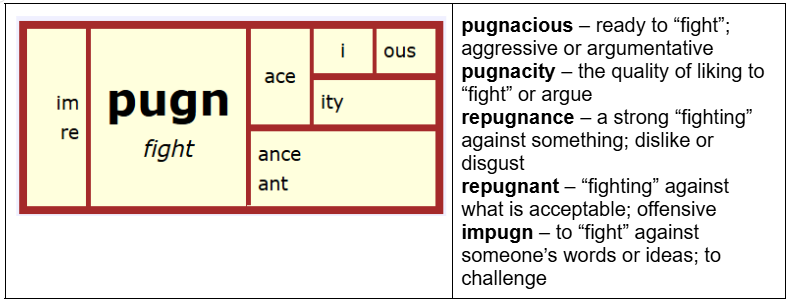
This is a yearly reminder on why Buffalo fans are called the most passionate fan base in the country. Now you know.
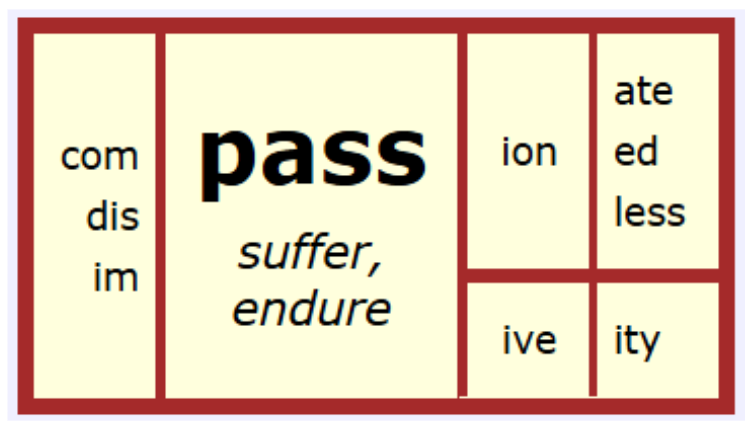
Morrisey explains:
I use a speech to print approach focusing on different spelling patterns for a particular sound, emphasize breaking words into syllables, daily dictation practice, and use morphology matrices that focus on prefixes, roots, and suffixes.
I, too, use a speech-to-print approach to teach the various spelling patterns for each sound, following developmental psychologist’s David Share’s recommendations in his recent article Blueprint for a Universal Theory of Learning to Read: The Combinatorial Model where he states:
Beginning readers of English are often (and wisely) first taught an oversimplified deterministic ‘rule’ that the letter a (as in cat) makes the sound / æ/. Consider this as the first shoot at the single-letter layer or branch. This bit of information is not discarded as the reader grows, but is gradually refined into a more nuanced context-conditioned probabilistic (primarily implicit) understanding that this correspondence works well as a general default decoding (especially in short monosyllabic words such as cat, bag, and stand), but has other sounds in more complex words depending on position and context (take, call care, wand, farm, team, play, boat, etc.).
Since first discovering SWI, I have engaged in an ongoing email discussion with Pete related to my acceptance of wisely teaching an oversimplified introduction to the alphabetic code. In addition to the recommendation by David Share, this position aligns with neuroscientist Stanislas Dehaene, cognitive scientist Mark Seidenberg, and educational psychologist Linnea Ehri. Looking in the brain, at computer simulations, and inside classrooms confirms for me the importance of establishing for my beginning readers the alphabetic principle, the connection between sounds (phonemes) and letters (graphemes) and how we use these connections to write (encode) and read (decode) words.
Simply stated, beginning readers can benefit from exposure to the stable spellings of the basic code, which has a transparent, one-to-one mapping between sound and print within CVC (consonant-vowel-consonant) words like cat and dog. This phonics first orientation jumpstarts the segmenting process (encoding speech to write) and the blending process (decoding print to read), both essential for proficient reading. While it is true that morphemes like ‘ed’ and ‘s’ can have stable spellings but varying pronunciations, that does not preclude teaching the consistency of the spellings of the simple, single-syllable, monomorphemic words that dominate during the very beginning of reading instruction before asking students to read more complex morphemes.
Pete often expresses his concerns about traditional phonics instruction, which he believes can instill a false expectation about the language and promote bad habits related to the relationships between letters and sounds—all of which, he asserts, will need to be undone at a later date. For more on his concerns, listen to this discussion on The Literacy View podcast.
In another podcast, For the Love of Literacy, Pete appears with Linnea Ehri, and she endorses Share’s oversimplified recommendation for beginning reading instruction while also agreeing with Pete about the crucial importance of introducing morphology as soon as possible. She explains the equally important roles that phonics and morphology play, which I later wrote about in What Was She Thinking: Linnea Ehri Explains Orthographic Mapping. She states:
Let’s take the tree analogy. It starts from effortful decoding in his [David Share’s] first phase. Readers need to learn letter-sound relations and phonemic awareness to develop their decoding skill. Then once that develops, their decoding skill improves, so the trunk of the tree grows taller . . . So he’s building these branches through his decoding skill. But the trunk of the tree goes from effortful decoding to skilled decoding. And then he’s got this supra lexical phase, where the reader is reading fluently and using the context to accumulate syntactic and semantic information and building that into the meanings of words.
Mark Seidenberg also emphasizes the importance of teaching code knowledge, though he is concerned that we are providing too much explicit instruction. He writes:
For typically developing children, the goal is ‘cracking the code,’ which happens when they have learned what there is to learn (patterns linking print, sound, and meaning) and enough patterns and words to begin reading sentences and longer texts.
I believe that many of the concerns Pete expresses related to beginning reading instruction fall under the umbrella of faulty phonics. Those of us who do not teach traditional phonics (see Rethinking Reading: A Look at Linguistic Phonics) avoid many of the pitfalls he is concerned about related to how we introduce these letter-sound relationships to students.
More importantly, morphology is definitely present during writing, if not reading, right from the beginning since children are telling so many stories using ing and they are often writing plurals, which are part of their natural speech. Providing guidance when students are writing these morphemes gives them exposure to the stable spelling of ‘s’ regardless of whether the sound is /s/ or /z/, something I recently explained to first graders reading about chicks and eggs.
You Say You Want a Mental Revolution?
I don’t want to spend time talking about the individual letters or sounds or whatever in a word. I don’t think it’s meaningful to talk about an individual word without putting it in context . . . One of the worst conditionings that I think we do with kids is teach them single sound-spelling from the beginning.
Bruce Howlett, For the Love of Literacy
It’s precisely because I do want to spend time talking and teaching about the letters and sounds in words from the beginning that a year ago I posted this piece on the SPELL-Links Blogue, Must Phonics Fail in Order for Structured Word Inquiry to Succeed? Here is how I begin:
There is a famous New Yorker cartoon of two dogs dressed in suits and ties sitting at a restaurant counter, perhaps having a business lunch. The caption reads: ‘It’s not enough that we succeed. Cats must also fail.’
I think of this cartoon every time I read or listen to anti-phonics folks argue that systematic phonics instruction is ineffective and needs to be replaced by a different method because, they contend, it has failed to show growth in reading comprehension in published research. It’s time to abandon phonics as we now teach it, they declare, and start over with something different like Structured Word Inquiry (SWI), which is literacy instruction that uses a scientific inquiry approach to build understanding of how English orthography represents the meanings of words to speakers of the language through an interrelation of morphology, etymology and phonology.
In ‘Learning to be literate: An orthographic journey with young students’ (2019), Pete Bowers and his co-authors begin by stating:
‘In this chapter, the authors argue that the alphabetic principle is a faulty guide for literacy instruction . . . When based on this understanding of English orthography, literacy instruction – especially in the early years – addresses phonological influences on orthography while ignoring the function of the other linguistic influences, namely morphology and etymology. The authors argue that it is critical to teach students about the interrelation of morphology, etymology and phonology; that is, to provide children with early literacy instruction that reflects more accurately how reading and writing work.’
It’s hard to see how there can be any reconciliation between the two camps—the canines and the felines—if the alphabetic principle is embraced by one side but rejected by the other.
This assertion that the alphabetic principle is a faulty guide for literacy instruction is directly contradicted by neuroscientist Stanislas Dehaene in Reading and the Brain, where the importance of the alphabetic principle is emphasized. He writes:
The goal of reading instruction becomes clear. It must aim to lay down an efficient neuronal hierarchy, so that a child can recognize letters and graphemes and easily turn them into speech sounds . . . Considerable research . . . converges on the fact that grapheme-phoneme conversion radically transforms the child’s brain and the way in which it processes speech sounds. This process whereby written words are converted into strings of phonemes . . . does not develop spontaneously, and must be acquired . . . A true mental revolution will take place before the child finds out that speech can be broken down into phonemes.
Also, this from neuropsychologist Jeannine Herron (Making Speech Visible) in Mapping Early Literacy:
Brain research shows that early reading requires development of neural pathways linking speech to new learning about print. Memorizing the visual appearance of words does not require the same participation of speech. More efficient brain pathways develop as children master PA, phonics, the alphabet code, and word knowledge in order to encode and decode meaningful text. These networks will be elaborated over time as new words, (their pronunciations, spellings, usage, and sometimes multiple meanings) are mapped and stored. When these neural maps are created and repeated, familiar words are no longer decoded intentionally, but are recognized automatically. Introducing morphemes to change words like play into plays, player, played, and playing can dramatically increase the number of words that are recognized automatically.
Over the years, I have been accused by linguists of not teaching the truth of the language, and my response has been that if teaching a convenient fiction—to borrow Mark Seidenberg’s term—helps my students crack the alphabetic code quickly and efficiently and sets them on the road to reading, I have no qualms about this deception.
Spelling at the Starting Line: A Distinction with a Difference
The importance of teaching morphology involves the awareness that there are stable spellings in morphemes that are not altered by variable pronunciations. For example, in the Wiley Blevins first-grade story Push and Pull, the three different pronunciations for the ‘ed’ spelling are represented in the words pulled, tugged, pushed, pressed, and needed. However, this story is read well-after students have acquired the alphabetic principle by reading many single-syllable, monomorphemic words, so they are more than ready to deal with this paradox.
The irony is that those of us like Jeannine Herron who take a speech-to-print approach (see Timothy Shanahan Points to a Possible Speech-to-Print Advantage) begin our lessons with encoding (spelling) followed immediately by decoding (reading), and we emphasize the stable spellings that SWI wants us to emphasize. However, we are simply teaching—at the beginning—the stable spellings of the basic code where there is in fact a one-to-one correspondence in consonant-vowel-consonant (CVC) words. The difference—and this matters—is that the basic code with CVC spellings (dog, cat, mom, dad) has both orthographic and phonological stability, which facilitates learning the alphabetic code in order to enable students to encode and decode (segment and blend), thus making the process manageable for emergent readers.
Pete and other morphology advocates are concerned that teaching this oversimplified code, as Share refers to it, to beginning readers is misleading. However, this is not the case because our students are also exposed to variability right from the beginning with common words like see and play as well as high-frequency words like what and was.
Once the mental revolution takes hold and children can proficiently encode and decode, they are open for business to layer on the complexity of multimorphemic words. This is not a paradox. We teach the oversimplification of the basic code to instigate the mental revolution, but we don’t shy away from sharing the variability of the advanced code as needed. Children are not flummoxed by encountering both wet and we in their decodable text because we actively teach set for variability (flexible pronunciations). When one of my English Learners recently read a story about going to a pet store and said poops instead of pups, she understood that there are variable pronunciations for ‘u’, and her job was to try a different sound and listen for a known word that makes sense—which she did.
My students understand that the advanced code is the big kids’ bicycle they will soon be riding, but we provide them the training wheels they need to secure their alphabetic balance first.
The student learning to read does not simultaneously juggle letter recognition, phoneme blending, vocabulary, syntax, and comprehension in one undifferentiated cognitive soup . . . Instead, systematic instruction builds stable subassemblies: letter-sound correspondences become automatic, freeing attention for blending; blending becomes automatic, freeing attention for word recognition; word recognition becomes automatic, freeing attention for meaning. Each level of the hierarchy stabilises before the next is built upon it.
Carl Hendrick, In Praise of Artificial Learning
What this all means is that while it is absolutely essential that we teach stable spellings with variable pronunciations, we don’t have to layer on the complexity of this mismatch between sound and spelling at the very beginning. Phonics and morphology can co-exist and fulfill their literacy functions without any kind of intentional overlap that might overwhelm the beginning reader.
Separate the Signal from the Noise: Fix Phonics
Phonics first, taught efficiently, with early exposure to the stable spellings in the morphemes ‘s’ and ‘ed’ followed by a logical progression of other morphemes, makes sense from both a theoretical and practical perspective. If you’re not getting the results you want with phonics instruction (see That Mark Seidenberg Blog), here are some possible reasons why:
You’re overteaching it and crowding out application to reading and writing.
You’re not integrating phonics with phonemic awareness instruction and simply having students silently complete worksheets.
You’re not emphasizing both encoding (writing) and (decoding) reading, which reinforce phonics skills taught.
You’re not promoting orthographic mapping by integrating letters, sounds, and meaning (phonology, orthography, semantics) to achieve automatic word recognition.
What matters is improving—not abandoning—that phonics instruction. Reading research by both Linnea Ehri and David Share has emphasized the importance of morphology instruction while not sacrificing the introduction of the alphabetic principle within beginning reading lessons.
From Carl Hendrick:
Complex systems do not become coherent by confronting the learner with everything at once. They become coherent because those stable subassemblies can be mastered, secured, and then combined. Without that temporary independence, complexity collapses into noise. The learner is forced to juggle too many interdependent elements simultaneously, and progress stalls not through lack of effort or intelligence, but because the system’s architecture exceeds the learner’s cognitive capacity.
In the numerous podcast discussions I have heard featuring SWI practitioners, I have found that its success with older students makes a lot of sense for all the reasons we know about morphology and why it matters, as I experienced with my third graders.
By contrast, any discussions and videos I have seen related to beginning readers have introduced a time-intensive complexity that is simply far inferior to the efficiency of the best phonics instruction. Mark Seidenberg’s advice to get in, get out—move on— makes sense. I would emphasize: move on to morphology.
Cat and Dog Are Morphemes
This video, Explicit instruction of GPCs in SWI from the beginning, with Pete provides the best illustration of why I believe using Structured Word Inquiry is not a good fit for beginning reading instruction because we see an added layer of complexity for beginning readers that is unnecessary, thereby undermining efficiency.
Before analyzing the video, here is a recent lesson sequence for one of my first grade reading groups learning the difference between the basic sounds for a, e, i, o, u in CVC words and for a _ e, e _ e, i _ e, o _ e, u _ e in CVCe words, followed by applying their newly acquired knowledge to reading stories reflecting these spelling patterns.
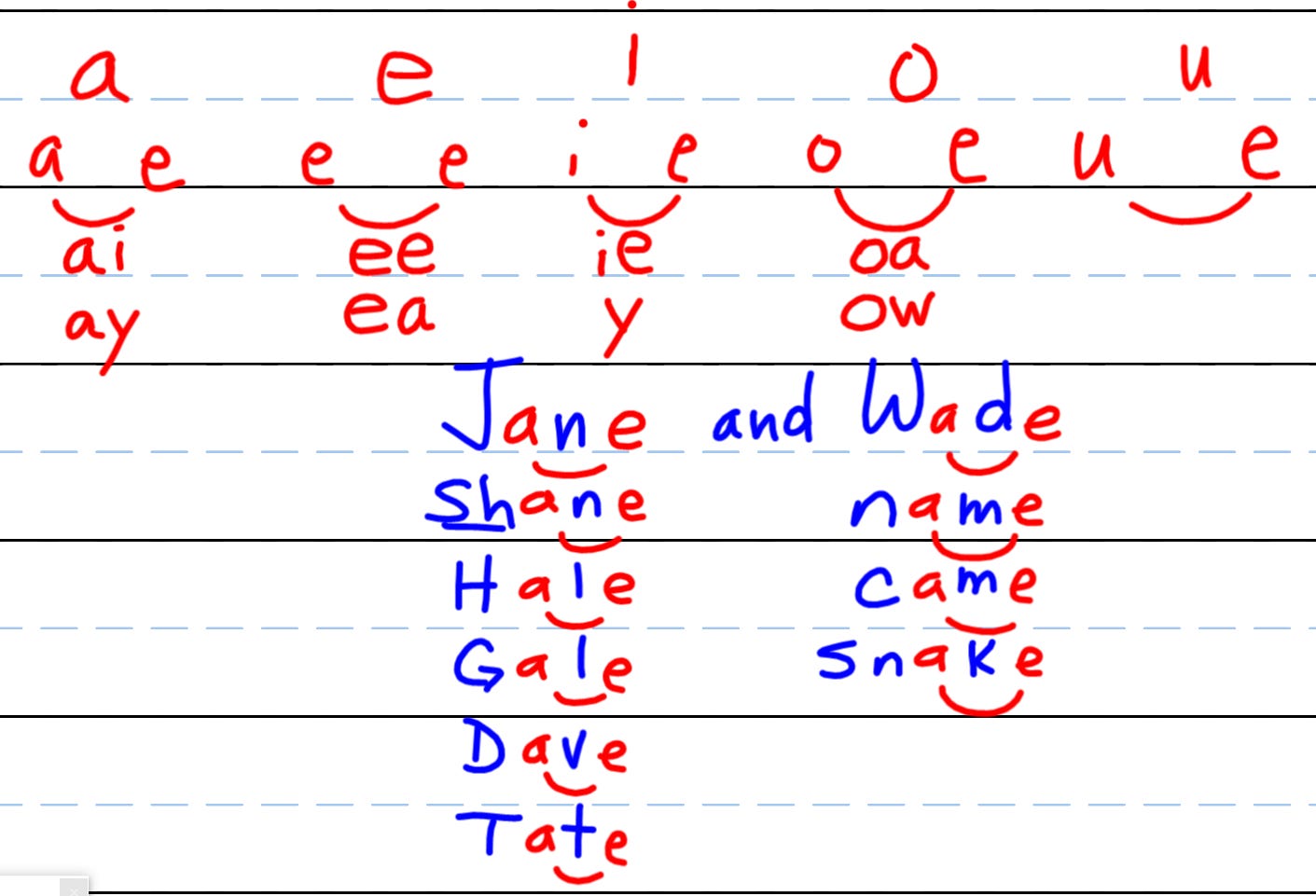
Word Chain with Magnets: mat, mate, mane, cane, can, ran, rat, rate, rake, make
Dictation of Story Words: Jane, Shane, Hale, Gale, Dave, Tate, name, came, snake
Reading Decodable Story: Jane and Wade
It was while making this word chain and asking my students whether they knew what a rake is that the following exchange occurred:
Student: I have two rakes.
Me: I have two, too.
Student (laughing): You have a tu tu? So do I.
I took advantage of this teachable moment to write the sentences on the board with the three different spellings for the same sound and also showed how they could remember two because they can hear the /t/ and /w/ in twins, twice, twelve, and twenty. But this is different from prioritizing these homonyms in initial instruction as Pete does in the video. What follows is an analysis of his methods.
The Homophonic Principle
Pete actually establishes the homophonic principle right from the start by saying to kindergartners and then discussing these two sentences: Come over here, kids; I can’t hear you. This is a great example of how our priorities differ at the beginning: Pete emphasizes that children who can’t read certain words can still see the difference between here and hear or see and sea, whereas I am far more interested in getting kids to read words rather than talking about them.
The difference between see and sea is something that is definitely discussed when introducing spelling variations for the /ee/ phoneme but not something I would dwell on unless it came up naturally, like two and too in the previous example. Pete’s method does show how to communicate the spelling principle, but it does not give me a roadmap for establishing the alphabetic principle, which is the precursor to reading that enables the mental revolution.
The Family Game
In the video, Pete also discusses playing the family game. He emphasizes that students don’t need to be able to read the words to play this game, which I find problematic. When I question this activity, however, I’m not questioning its validity per se but rather its inclusion as part of teaching non-readers how to read as opposed to a separate activity of investigating words and how they relate to each other. I keep returning to this distinction because it matters.
The game Pete plays involves pulling words out of a bag that have the same base: play, plays, played, playful, playmate, and he also includes words like day and plane, that don’t have the same base. Pete emphasizes his spelling out process—one tap on his arm for each single-letter grapheme and quick taps in succession for each letter in a multi-letter grapheme. He asserts that he is building mental representations, but my understanding of Seidenberg’s triangle model, Ehri’s theory of orthographic mapping, and Perfetti’s lexical quality hypothesis is that it’s not the spelling out of letters that matters, but the attachment of phonemes to graphemes—and both to meaning—that is essential.
Spelling analysis can deepen understanding—of course it can—but it presupposes a functioning decoding system within the reading process. The examples in the video put the cart before the horse. The analysis Pete gives us of word families refine representations—but they do not create them. Without phoneme–grapheme attachment, spelling remains inert knowledge rather than a mechanism for fluent word recognition, which is necessary for comprehension.
Spelling Out Words
Pete presents two sentences:
Mom says she wants a cat.
Mom says she wants a chat.
In both cases, he is spelling out—rather than sounding out—the words cat and chat, but with cat it’s one tap on his arm for each letter whereas with chat it’s two quick taps for ‘c’ and ‘h’ to indicate that they form a single grapheme. In neither case, however, is sound attached to print, which is necessary to facilitate orthographic mapping.
Introducing Plurals
Pete also refers to this story he wrote, Friendly Cats and Dogs:
My friend takes care of many stray cats. I always see two or three walking around his house. If I look closely, there is often at least one shy cat hiding in a corner somewhere too!
He uses this passage to highlight the difference between the singular and plural forms and how we add ‘s’ to the base to achieve this. My English-speaking kindergartners already use these forms in their spoken language, so it’s not something I would single out in print that is too complicated for them to read, though I do point it out for their writing. However, as mentioned above, when reading a decodable text that uses the words chicks and eggs, I indicate the stable spelling of ‘s’ despite the different pronunciations: /s/ and /z/. But these are words in stories that my students are actually reading, unlike the ones in Pete’s story that are beyond the reach of beginning readers.
Pete goes on to a second paragraph in the story, equally complicated as the first.
He also likes dogs. In this picture we see that this dog and these cats are friends who are used to hanging out together. It’s lovely to see cats and dogs play together nicely.
To repeat, spelling out words may support reflection about language, but attaching phonemes to graphemes is what builds the mental infrastructure that makes reading possible in the first place.
The names of letters . . . far from being helpful, may even delay the acquisition of reading . . . Letter names cannot be assembled during reading—the hookup only concerns phonemes.
Stanislas Dehaene, Reading in the Brain
Here are the main problems with Structured Word Inquiry for beginning readers:
a de-emphasis of the alphabetic principle
unnecessary complexity for beginning readers
inefficient use of time talking about words
spelling out graphemes rather than linking phonology with orthography
We’ve previously discussed the importance of scaffolding from simple to complex when teaching morphology, with consideration of specific factors such as phonological and orthographic transparency, concreteness vs. abstractness of morpheme meaning, and frequency of occurrence of morphemes in the language.
Jan Wasowicz, SPELL-Talk Listserv
After Decoding, What?
In my SWI blog posted on SPELL-Links, I end by stating:
In ‘After Decoding, What?’ Carol Chomsky recommends fluency building to get children ‘a step closer to the real activities that contribute to literacy: interacting with print in the world at large.’ That’s our goal for decoding instruction: getting our students to interact with print as often as possible both on and off the beaten path of explicit classroom instruction—to engage in wide reading, widely available. What is the most efficient and effective way of fostering this interaction?
Our goal is to make beginning reading instruction both efficient and effective based on our best understanding of the research. In Neuroscientists and Neophytes Concur: Using Common Sense Can Make the Most Sense I lean heavily on not discounting the course dictated by common sense. It is this common sense—coupled with recommendations from the researchers I have cited and my own experiences—that guide me when grappling with how to teach my beginning readers.
Explaining our practices by providing our reasons for these choices invites feedback for improvement. This communication brings our choices into the limelight for all to see and scrutinize in the spirit of advancing best practices. I have attempted to show that explaining spelling is not the same as teaching reading.
Structured Word Inquiry prioritizes orthographic stability over phonemic mapping, which may be beneficial after mapping is established, but it does not efficiently support the necessary formation of initial word representations. If we leapfrog the process of attaching graphemes to phonemes, we risk failing to secure orthographic mapping. The importance of this step has been confirmed by both research and the hundreds of students I have worked with in my reading intervention groups.
Whatever its merits related to morphology instruction may be, I am convinced that Structured Word Inquiry is neither the most efficient nor the most effective way to teach beginning reading.
There is no simple fix for reading, but there are many ways to get it wrong.
Mark Seidenberg
Always striving to make sense—please let me know when I fail.
Crushed it.
Harriet, you weave together many research and logic threads so well here. An excellent service to the field.
Fighting the research base on the need to first acquire the alphabetic principle and sound-symbol mapping is a quixotic endeavor.
Harriett, for readers who are interested in exploring the fallacies of SWI further, this article is also a helpful read.
https://www.nomanis.com.au/blog/single-post/why-phonology-comes-first